
Gas Security Is Energy Security — and Bio-Methane CCHP Is the Missing Half
Sep 28, 2026 · @John C Burke
Britain's gas system is the foundation of its energy security, and policy has been treating it as a problem to retire rather than an asset to secure. That is the core finding of Gas Security: The Foundation of Energy Security, published in September 2026 by Kathryn Porter of the independent consultancy Watt-Logic. [Download her Full Report HERE]
For readers of Sun Earth Energy, the report is welcome confirmation of arguments we have made for over a decade. Porter supplies the market diagnosis. This article sets out the prescription her report leaves out: bio-methane in the gas grid, burned in high-efficiency combined cooling, heat and power (CCHP), inside an integrated urban energy system.
The two halves belong together. Her work shows why the gas network must be kept strong. Ours shows how to make it domestic, renewable and far more efficient.
The diagnosis: what Porter's report finds
Porter's central finding is that gas's role is more enduring, and the gas system more fragile, than current policy assumes. Her evidence falls into six points.
- Electricity is only part of the story. Even fully decarbonised, electricity meets only about a fifth of UK final energy demand. Space heating and industrial process heat remain on gas for decades.
- The heat-pump arithmetic does not work on current timescales. Around 23–24 million homes use gas boilers. The UK installed about 105,000 heat pumps in 2025, a record year. Even at the reduced target of 450,000 a year, replacing the boiler stock would take around 50 years.
- Networks, not gas, are now driving bills up. Wholesale and network costs have both roughly doubled since 2017. Constraint payments more than trebled to £1.9 billion in 2025–26, and the National Audit Office has criticised the Connect & Manage approach.
- The North Sea could fall off a cliff, not a slope. Offshore pipelines such as CATS, SAGE and FLAGS need a minimum throughput to stay viable. The 2018 Theddlethorpe closure stranded 22 Southern North Sea fields at once.
- Storage is thin. Britain holds around sixteen days of gas demand in storage, and the future of Rough still awaits a funding decision.
- Imports are not guaranteed under stress. Norwegian reservoirs are at twenty-year lows, the French nuclear fleet is ageing, and cold, still weather tends to hit Britain and its neighbours at the same time.
Her recommendations follow: fix the misunderstanding of how gas is priced, raise domestic production, cut reliance on electricity imports, model gas and electricity together, focus on cheap energy, and treat energy security as national security.
Policymakers are chasing the wrong target
UK energy policy has aimed at the electricity grid, while most of the energy people actually use arrives through the gas grid. Porter's report shows the cost of that narrow aim: rising network bills, a neglected gas system and a heating transition measured in half-centuries.
The right target is the energy service delivered: warm homes, hot water, cooling, process heat and power, from the least primary energy. Measured that way, the question is not "gas or electricity?" but how efficiently each unit of fuel is used, and where that fuel comes from.
Reframing the methane question
Methane has become shorthand for everything policy wants rid of, including the methane that safely heats 23 million homes. Porter works within the emissions debate rather than against it, and her report turns that debate in gas's favour: UKCS pipeline gas is cleaner than imported LNG.
The distinction that matters is methane that escapes versus methane that is captured and used. Landfill, sewage, slurry and food waste release methane whether or not we collect it. Anaerobic digestion captures that methane, upgrades it to grid quality and burns it for useful energy. Kept in the pipe and used efficiently, CH4 is part of the solution.
The missing prescription: bio-methane, CCHP and URBium
Porter's report never mentions bio-methane, combined heat and power or demand reduction. These are the tools that turn gas security from an import problem into a domestic, renewable strength.
Bio-methane is methane captured from food waste, sewage, slurry and farm residues through anaerobic digestion, then upgraded to grid quality. It is chemically the same as natural gas. It uses the existing pipes, storage and appliances, and it adds home-grown volume to the network Porter warns is at risk.
CCHP burns gas locally to make electricity, and captures the heat that large power stations throw away. That heat serves buildings through heat networks, or drives absorption chillers for cooling. Well-matched CHP uses up to around 90% of the fuel's energy, against roughly 35–50% for power-only generation.
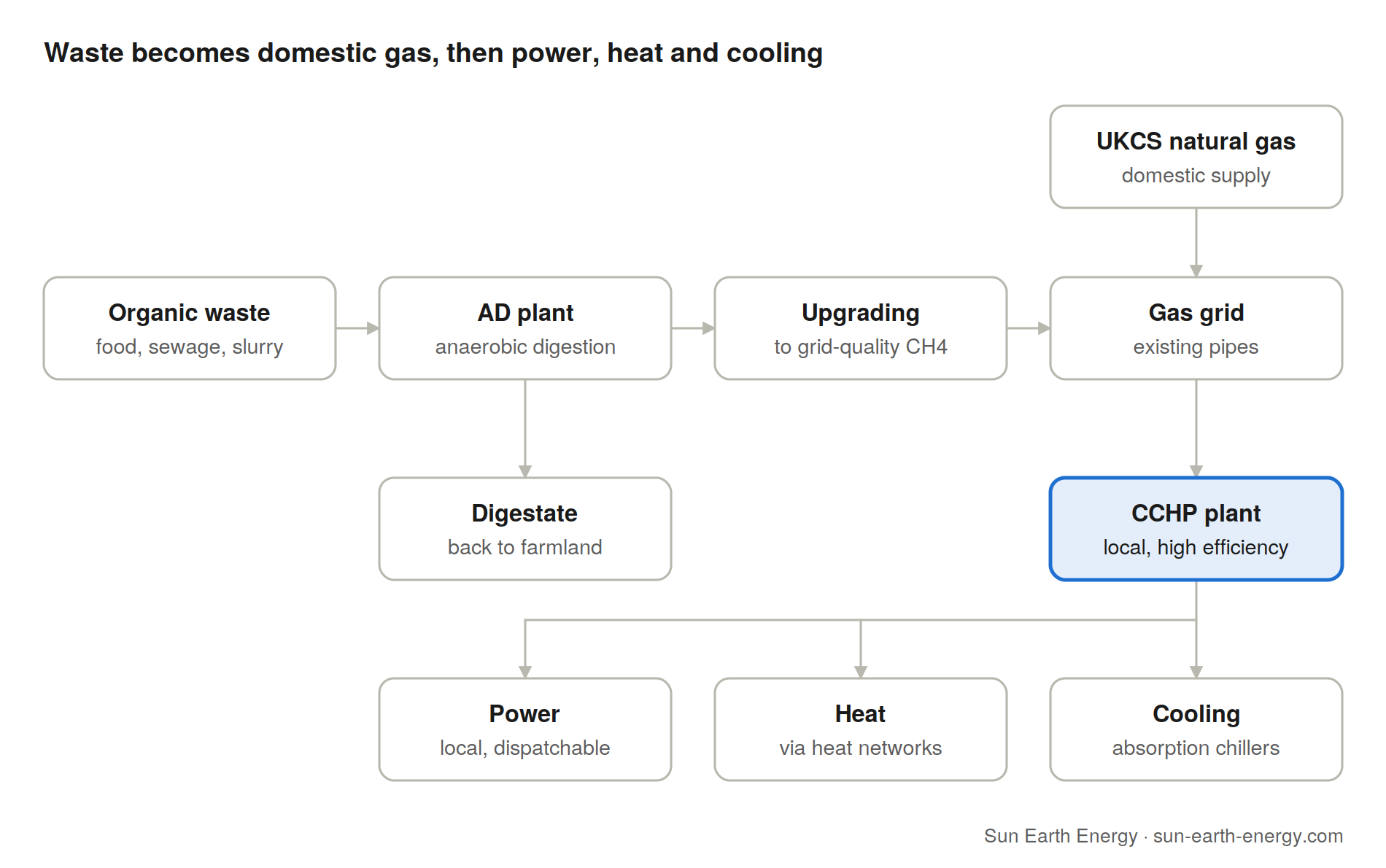
The same grid carries both domestic natural gas and bio-methane, and local CCHP turns each unit into power, heat and cooling at once.
URBium brings these together as integrated urban metabolism. It treats a city's waste, water, heat, cooling and power as one system, so that each output becomes another's input. Urbium Research Ltd leads the research; Sun Earth Energy Ltd leads delivery.
How the prescription answers each risk
Every major risk in Porter's report has a direct answer in bio-methane CCHP. The table pairs them.
|
Porter's risk |
What bio-methane CCHP contributes |
|
Declining UKCS output and pipeline cliff edges |
Adds domestic gas volume to the grid, and cuts the gas needed per unit of energy service |
|
Heavy reliance on imported LNG |
Replaces marginal imports with gas made from UK waste streams |
|
Unreliable electricity imports in cold, still weather |
Provides local, dispatchable power that does not depend on Norway, France or the wind |
|
Rising network and constraint costs |
Generates power near demand, easing the need for long new transmission lines |
|
Heat-pump rollout measured in decades |
Decarbonises heat through the existing gas grid and appliances, starting now |
|
Gas and electricity planned in separate silos |
Joins gas, power, heat and cooling in one system, as she recommends |
|
Weak gas storage |
Local bio-methane production and heat-network thermal stores add resilience at the point of use |
A policy agenda that combines both
Porter's recommendations secure the gas system; ours make it more efficient and more renewable. Together they give policymakers a complete agenda.
- Measure energy services, not just electricity. Judge policy by the primary energy used to deliver heat, cooling and power, across both grids.
- Keep the gas grid, and plan for it to carry more bio-methane. Decommissioning debates are premature while the grid delivers most of Britain's heat.
- Back domestic gas of every kind. Support UKCS production and critical pipelines, as Porter proposes, and set a national programme for anaerobic digestion and bio-methane injection.
- Put CCHP and heat networks at the centre of heat policy. Local generation eases network costs and provides the dispatchable power she shows Britain lacks.
- Sequence properly: fabric first. Cut demand through insulation before choosing heating technologies, so every unit of gas does more.
- Treat energy security as national security. Domestic, waste-derived fuel and local generation are the most secure supplies Britain can have.
Conclusion
Gas security is energy security, and methane used well is part of Britain's answer, not its problem. Porter has shown why the gas system must be protected. Bio-methane CCHP and integrated urban metabolism show how to make it domestic, renewable and far more productive per unit of fuel.
The policy target should move from electricity alone to the whole energy system. When it does, the gas grid stops looking like a liability and starts looking like Britain's most valuable energy asset.
Further reading
|
Resource |
What it covers |
|
Kathryn Porter's independent analysis, including Gas Security: The Foundation of Energy Security (September 2026) |
|
|
Our delivery work on bio-methane CCHP and efficiency-first energy systems |
|
|
Integrated urban metabolism research, led by Urbium Research Ltd |
|
|
Combined heat and power: technical resources, efficiency data and UK installations |
|
|
Bio-methane: anaerobic digestion, waste-to-energy and integration with CHP |
Contact: